

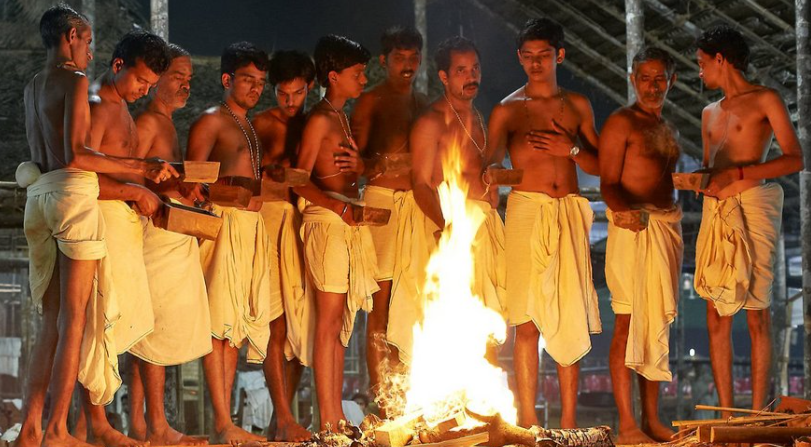
For the first time in its long history, the ancient Vedic ritual of Athirathram has come to Kozhikode, transforming the city into a living canvas of chant, fire, and collective prayer. Organized by the Kashyapa Veda Research Foundation under the spiritual leadership of Vedacharya Acharyashri Rajesh, the Athirathram Maha Yagam is being conducted from April 17 to April 26, 2026, at the Kakkodi Veda Mahamandiram in Kozhikode. This 10‑day event is not just a religious ceremony but a bold statement of cultural continuity, openness, and scientific interest in the older Indian knowledge systems.
What is Athirathram?
Athirathram is one of the most significant and longest‑duration rituals among the Shrauta Yagas, a class of elaborate Vedic sacrifices that have been preserved for thousands of years, especially in pockets of Kerala. The name itself carries deep symbolism: “Athirathram” literally means “beyond the night,” because the central Soma offerings that begin during the day continue through the night and into the next morning. In an ordinary Agnishtoma Somayagam, Soma is offered in three main sessions Pratah‑savanam (morning), Madhyandina‑savanam (midday), and Thrithiya‑savanam (evening). In Athirathram, additional special offerings are performed during the night, pushing the ritual “beyond” the usual temporal boundaries and giving it its distinctive character. Scriptural tradition holds that the purpose of Dravya Yajnas like Athirathram is to re‑enact the process of cosmic creation and to restore harmony between humans, nature, and the divine. Ancient texts associate such yagas with the restoration of natural rhythms, spiritual elevation of the participants, and the strengthening of social unity. Athirathram is often described as a microcosmic re‑creation of the universe sung into existence through precise mantras, fire, and disciplined ritual choreography.
Why is Athirathram in Kozhikode Historic?
The Kozhikode Athirathram marks a turning point in the ritual’s geography. Until now, large‑scale Athirathram events have been concentrated in a few traditional centres; bringing this 3,000‑plus‑year‑old practice to a major urban centre like Kozhikode signals both preservation and adaptation. Organizers from the Kashyapa Veda Research Foundation have framed this as a “first in history” iteration for the city, underlining the role of Kozhikode as a melting‑pot where trade, culture, and now Vedic ritual, converge in a new context. The venue, Kakkodi Veda Mahamandiram, is being transformed into a full‑fledged yagashala, complete with multiple altars, sacrificial fire pits, and designated spaces for the several priests known as Rithwiks. Each of these priests represents a specific Vedic branch Rig, Yajur, Sama, and Atharva ensuring that the ritual unfolds as a four‑dimensional symphony of sound, fire, and geometry. The fact that this event is being held in the 21st‑century setting of Kozhikode, with modern transport, social media, and digital documentation walking hand‑in‑hand with age‑old chants, makes it a powerful case study in how ancient practices can remain relevant in contemporary India.
Inclusivity and Social Message
One of the most striking features of the Kozhikode Athirathram is its open‑entry policy. Unlike older, more restricted forms of yagams, this event explicitly welcomes everyone, regardless of caste or gender. Organizers emphasize that the ritual is dedicated to “mankind” in a universal sense, not to a particular community or sect. This inclusivity is not just a symbolic gesture; it affects who is present at the venue, who can observe the rites, and who can participate in the surrounding discourses and exhibitions. Local coverage and social‑media posts describe Kakkodi Veda Mahamandiram overflowing with thousands of attendees on the opening days, from children to elders, students to professionals, and both devotees and curious onlookers. The event is being projected as a festival of spiritual awakening rather than a closed esoteric ceremony. By explicitly rejecting exclusivity, the organizers are using the high‑cultural capital of Athirathram to push a message of unity, peace, and shared heritage values that resonate deeply in a city as diverse as Kozhikode.
Cultural and Scientific Dimensions
Beyond the strictly ritual level, the Athirathram in Kozhikode comes with a strong cultural and research component. The campus hosts an exhibition on the historical development of Indian mathematics and astronomy, linking the geometric precision of Vedic yagashalas with ancient Indian scientific thought. Temple and altar designs, the positioning of altars relative to the cardinal directions, and the use of precise measurements in ritual construction are all presented as evidence of a sophisticated scientific layer embedded within the religious framework. Another unique aspect of this edition is that the entire Athirathram is being video‑documented for research purposes. Unlike many earlier yagas that were recorded only in manuscripts or short notes, this 10‑day event is being captured in detail, creating a valuable archive for future scholars of Vedic studies, anthropology, and even sound and cognitive science. The decision to treat the ritual as both a living tradition and a research object underlines a shift from purely devotional engagement to a more analytical, interdisciplinary approach.
Daily Structure and Ritual Highlights
While the exact day‑wise schedule of mantras and offerings is complex and follows an intricate Vedic timetable, the broader arc of the Athirathram in Kozhikode can be understood in stages. The first few days typically involve the preparation and consecration of the yaga‑shala, the pollution‑free space where the altars are built and the sacred fires are kindled. This is followed by the beginning of the Soma‑offering sequence, where pressed Soma juice is offered into the fire according to strict Vedic prescriptions. The middle days intensify the pace, with multiple rounds of Soma‑huti performed at different times of the day, including the special night sessions that give Athirathram its name. On these nights, the chant flows continuously, the fire glows steadily, and the entire space becomes a zone of heightened awareness and collective focus. The final days are marked by ritual culmination and closure, including the symbolic immersion of used ritual items in water and the ceremonial extinguishing or transfer of the sacred fire. Throughout, the atmosphere is carefully managed to maintain a balance between public participation and ritual precision.
For Kozhikode, a city known for its liberal intellectual culture, vibrant arts scene, and cosmopolitan history, the arrival of Athirathram offers a chance to reflect on how tradition can coexist with modernity. The event is not framed as a retreat into the past, but as a living experiment in continuity. With its blend of ancient Vedic pulse and contemporary urban energy, the Athirathram at Kakaodi Veda Mahamandiram, Kozhikode, 2026 stands as a landmark moment in the cultural life of the city.