

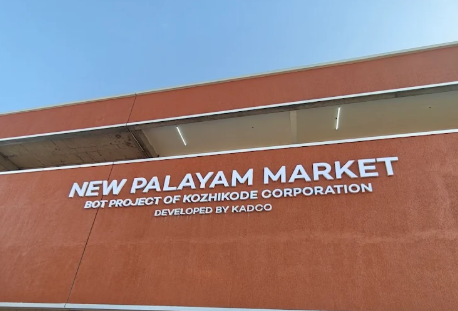
New Palayam, or the New Palayam Market Complex at Kalluthankadavu, marks a turning‑point in Kozhikode’s urban economy and cityscape. It is not just a “new market” in the literal sense; it is a reimagining of how Kozhikode trades, moves, and lives in the 21st century, reshaping one of the city’s oldest commercial identities.
What is New Palayam?
New Palayam refers primarily to the New Palayam Market Complex, a modern retail and wholesale hub built at Kalluthankadavu, a few kilometres from the original Palayam junction in central Kozhikode. The project, inaugurated by Chief Minister Pinarayi Vijayan in October 2025, is a public–private partnership (PPP) scheme implemented at a cost of roughly ₹100 crore. It is being positioned as the first large‑scale PPP‑based market infrastructure project in Kerala, and one whose scale and design are meant to ease congestion, modernise supply chains, and give Kozhikode a new commercial spine.
From heritage Palayam to Kalluthankadavu
The old Palayam market in central Kozhikode has long been more than a vegetable and fish market, it was a cultural and economic landmark, inseparable from the city’s identity. Relocating this heritage market to Kalluthankadavu, however, has triggered sharp debate. Authorities argue that the shift was necessary to decongest the city centre, improve traffic flow, and comply with the broader Master Plan framework for Kozhikode Urban Area, which envisages decentralised commercial and residential nodes to accommodate rapid urbanisation. The new complex at Kalluthankadavu is designed to house over 300 shops, including space for wholesale, retail, and ancillary services, along with modern sanitation, storage, and ample parking. In official narratives, this is framed as a new chapter in Kozhikode’s commercial growth, where traditional trade is uprooted from the narrow streets of the old town and transplanted into a structured, hygienic, and vehicle‑friendly environment.
The controversy and resistance
At the time of inauguration, the opening of New Palayam was met with protests from sections of traders and labourers who worked in the old Palayam market. They argued that they had not received due consideration in the relocation plan and that the new site at Kalluthankadavu was less accessible and less suitable for their existing customer base. Some vending groups and unions raised concerns about rent levels, parking charges, and the loss of footfall that came with the move from the heart of the city. Despite the demonstrations, the state government has maintained that such transitions are inevitable in any serious attempt to modernise urban infrastructure. The Chief Minister, speaking at the inauguration, observed that “it will always be difficult for some people to accept development,” implying that the discomfort of the short term must be weighed against the long‑term vision for Kozhikode as a more organised, healthier, and better‑connected city.
Urban impact and traffic dynamics
From an urban‑planning standpoint, shifting the major wholesale and retail market away from the central Palayam junction is intended to ease one of the biggest bottlenecks in Kozhikode city. The old market saturated the area with trucks, mini‑vans, handcarts, and pedestrians, creating a permanent gridlock that affected movement between the railway station, the bus stand, and the city’s main commercial streets. By relocating this bulk of trade to Kalluthankadavu, planners hope to restore mobility on the inner‑city roads and create room for better traffic management, pedestrian zones, and integrated public‑transport corridors. Kalluthankadavu itself is an area that has been gradually gaining significance in Kozhikode’s suburban expansion. Its selection as the site for the New Palayam Market signals a deliberate policy of pushing high‑density commercial activity away from the already congested core and towards emerging suburban nodes, which also aligns with the broader Kozhikode‑urban‑area master‑plan logic. Over time, this could shape a new sub‑central business district around Kalluthankadavu, complete with warehousing, logistics, and allied retail services.
Facilities and the “modern market” model
The New Palayam Market Complex is built as a multi‑story, mixed‑use facility rather than the open‑air or semi‑covered market typical of older Indian cities. Besides the more than 300 shops, the complex includes modern hygienic facilities, cold storage‑linked spaces for perishables, and dedicated parking for both commercial vehicles and customers. Sanitation and waste‑management infrastructure are also highlighted as central features, with the stated aim of reducing the foul odour, litter, and wastewater issues that had become associated with the older market. For the discerning Kozhikode shopper, the new complex promises a more organised experience: better‑lit stalls, standardised units, and, in time, the possibility of digital payment points and inventory‑management systems for larger vendors. However, some traders complain that the rents and user‑charges in the new complex are higher than the loosely regulated, historically low‑cost stalls of the old Palayam, and that this may eventually push small vendors to the margins or back into informal roadside vending.
For Kozhikode, New Palayam is more than a building; it is a statement about the kind of city Kozhikode wants to be. It is a place where the old market romance of Palayam is overlaid with the cold, efficient geometry of a modern commercial complex, and where the residents must decide whether they miss the chaos, or celebrate the order.